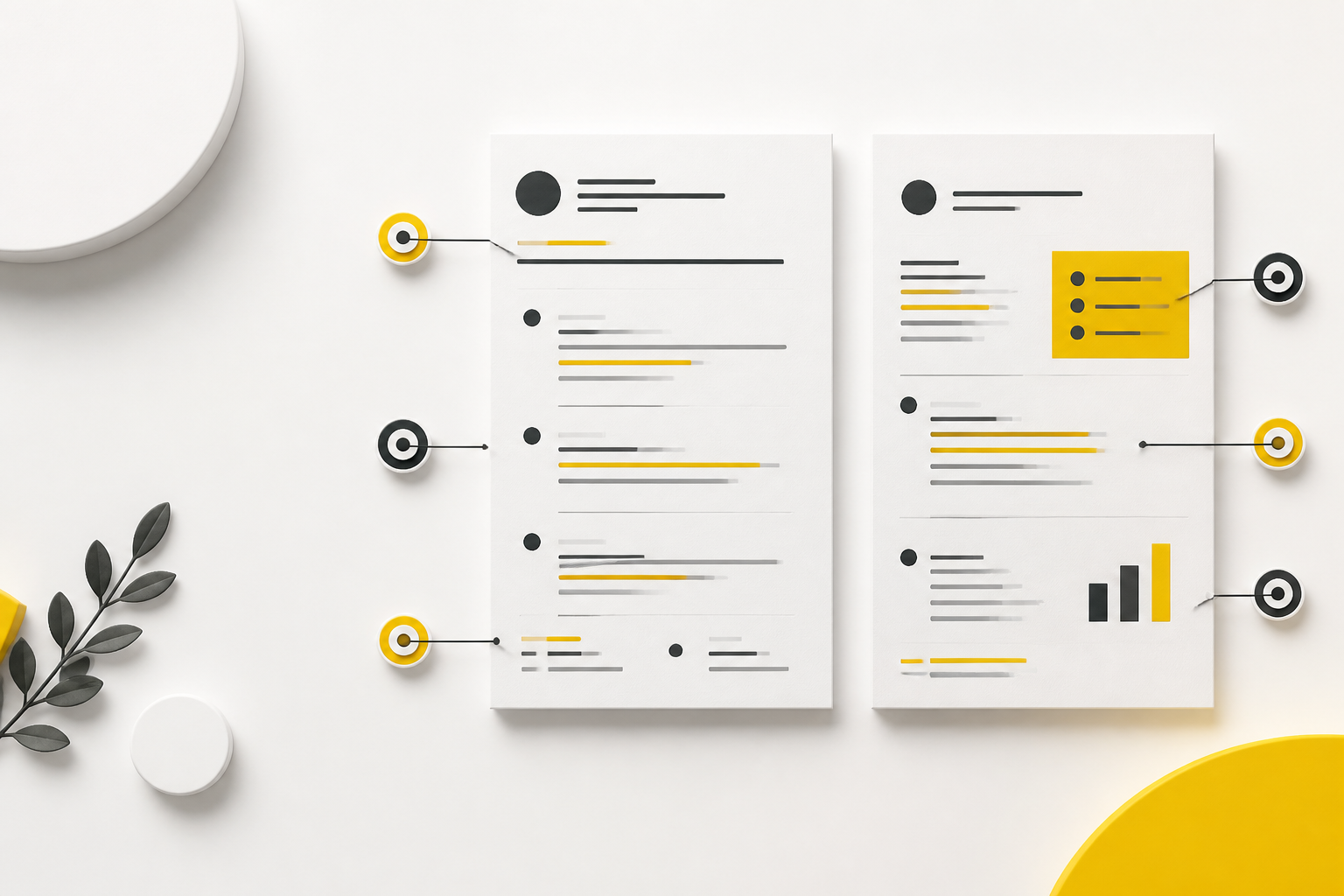
The cover letter template at a glance
Start with your name and contact details, the date, and the employer or hiring team where that detail is available. Then use a professional greeting, a short opening, two body paragraphs, and a closing. The structure is simple because the work is in choosing the right evidence, not in making the page look elaborate.
Opening template: role, context, reason
Try this structure: "I am applying for the [role] position. In my recent work as [current or relevant context], I have developed experience in [closest capability]. I am interested in this opportunity because [specific employer or role connection]." Replace the brackets with precise facts. If the last sentence could apply to any employer, research the role further before sending.
Evidence paragraph template: situation, contribution, outcome
Use this sequence: "In [context], I was responsible for [your specific contribution]. I worked by [method, decision, or collaboration]. This resulted in [accurate outcome]. That experience would help me contribute to [relevant part of the target role]." You do not need a dramatic metric for this to work. Better quality, clearer decisions, reduced risk, or a difficult delivery can be meaningful outcomes when explained honestly.
Second paragraph template: complementary proof
Use the second paragraph to show a different but relevant capability. This might be stakeholder communication, technical depth, customer understanding, leadership, or a credible career-change bridge. Avoid adding a list of every skill. The paragraph should answer a question the first example did not answer.
Employer connection template
A useful connection looks like this: "I am particularly interested in [company or team] because [verifiable detail]. My experience in [relevant evidence] has shown me the importance of [shared challenge or value], and I would welcome the chance to contribute to [specific work]." Never invent familiarity with the company, and do not repeat marketing language you cannot discuss naturally.
Closing template
Keep the ending brief: "I would welcome the opportunity to discuss how my experience in [capability] could support [team or role objective]. Thank you for considering my application." Include any availability or portfolio note only when it is relevant to the employer’s instructions.
How to adapt the template for a career change
State the target direction early, then identify transferable evidence without pretending the previous title is identical to the new one. For example, an operations specialist moving into project management can point to planning work, dependency tracking, stakeholder updates, and risk handling. Add the preparation you have completed, but let practical experience carry the argument.
How to adapt the template for a fresher
Use a substantial project, internship, part-time role, or leadership responsibility. Explain what you personally did, not simply what the team delivered. A fresher application feels stronger when it makes potential visible through concrete work and a realistic connection to the role.
Mistakes that make a template look copied
Avoid leaving placeholders, using vague praise for the employer, repeating the resume line by line, and adding claims such as "perfect fit" without proof. Read the finished letter aloud. If it sounds like anyone could send it, replace broad adjectives with a factual detail or remove the sentence.
Final pre-send checklist
Confirm the role title and company name, check every date and result against your resume, remove unsupported claims, ensure the attachment name is professional, and proofread the first and final paragraph twice. A clean template saves time, but the final check protects credibility.
Frequently asked questions
Questions people ask before they write.
Can I use the same cover letter template for every job?
Use the same underlying structure, but revise the opening, selected evidence, employer connection, and close for every meaningful application.
Should I use a free cover letter template from Word?
A simple Word template can work if the layout is readable. The quality of the content and relevance to the role matter far more than decorative formatting.
Is it acceptable to use AI to fill a cover letter template?
Use AI only as a drafting aid after you have supplied accurate facts and reviewed every sentence. A generic letter or invented achievement can weaken an application quickly.